
Tier List Frame
- Format
- Static, Carousel, Video
- Category
- Authority / Engagement
- Stage
- TOF, MOF
- Requires
- A ranking you'd defend in the comments
What is it
A ranked grid with coloured tier labels down the left, S at the top through to C, D or F at the bottom, and products, options or characters sorted into each row. It's a native internet format people already know how to read and love to argue with. The viewer's eye goes straight to "where did they put mine?", and the ranking positions the brand or creator as the expert who has tried everything. Disagreement is part of the mechanism: tier lists pull comments, and comments pull distribution.
What makes it work
Use the standard colour ladder
Red S, orange A, yellow B, green C, then blue or teal below. It's the visual language people know from gaming and creator culture, and it reads in a glance without labels. Reinventing the colours or letters makes the audience work to decode it.
Your pick goes in S, but not alone
The product or recommendation belongs in the top tier, surrounded by a few genuinely good alternatives. A top row with only your product looks like an ad disguised as a ranking. Credibility comes from ranking things you don't sell fairly.
Include something controversial
A popular option placed lower than people expect, or a niche one ranked high. That one surprising placement is what drives the "wait, why is X in C?" comments, and that's where reach comes from. A list that simply confirms the consensus gets a nod and a scroll.
Consistent, clean cut-outs
Every item isolated on the same background, similar scale, similar angle, with a small label beneath if names aren't visible. Mismatched product shots make the grid look chaotic, and the eye can't compare across rows.
Put a face or a handle on it
A creator avatar and handle in the header turns the list into someone's opinion rather than a brand's catalogue. That's what makes it believable and shareable. For brand-run lists, a named expert or "our team ranked" works better than an anonymous logo.
Leave room in the grid
Empty cells in a row signal that the ranking is selective, not padded. It also makes the S row feel rarer and more valuable.
Ranking real competitors has rules
Placing named competitor products in low tiers is comparative advertising. In the EU and Germany it has to be based on objective, verifiable criteria and can't denigrate, and supplement rankings also shouldn't imply health benefits that aren't approved. Keep the criteria clear ("ranked by value for beginners") and don't use other brands' logos or licensed characters as design elements.
Reference 1
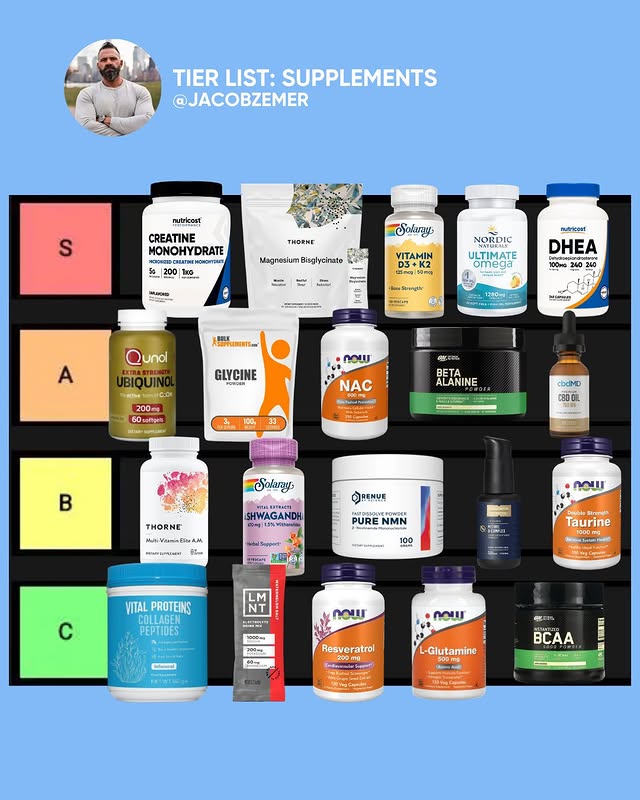
AI Edit Master Prompt
Using the attached image as the layout reference: keep the flat bright blue background, a header at the top with a circular creator portrait on the left and beside it a bold all-caps white title with a smaller all-caps handle beneath. Below keep a dark tier-list grid with four rows, each opened by a square coloured tier tile holding a single dark letter — red, orange, yellow and green from top to bottom — and each row filled with clean photographed product cut-outs of similar scale standing side by side, slightly overlapping the row edges. Replace the portrait with {YOUR CREATOR OR EXPERT PHOTO}. Set the title to "{TIER LIST: YOUR CATEGORY}", the handle to "{YOUR HANDLE}", and fill the rows with "{S-TIER PRODUCTS INCLUDING YOURS}", "{A-TIER PRODUCTS}", "{B-TIER PRODUCTS}" and "{C-TIER PRODUCTS}".Reference 2
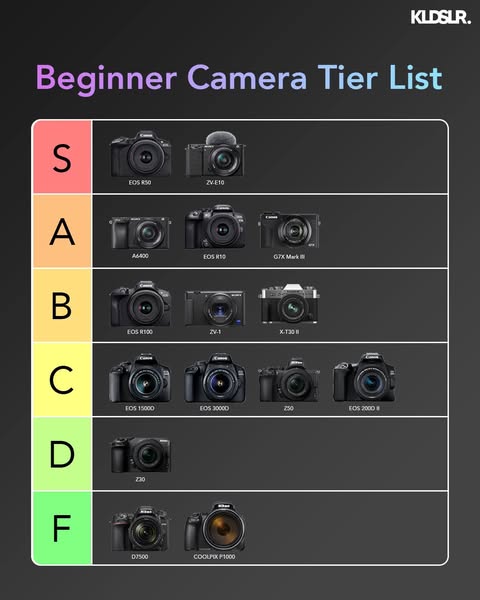
AI Edit Master Prompt
Using the attached image as the layout reference: keep the dark charcoal gradient background, a small white wordmark in the top right corner, and a large bold headline centred near the top in a soft pastel gradient. Beneath keep a rounded rectangular tier-list table with thin white outlines and six rows, each opened by a coloured tile with a large letter — red, orange, amber, yellow, green and bright green from top to bottom — and each row holding small, evenly spaced product cut-outs on the dark background, each with a tiny white name label beneath, leaving empty space on the right of shorter rows. Set the wordmark to "{YOUR BRAND}", the headline to "{THE AUDIENCE} {YOUR CATEGORY} TIER LIST", and fill the rows with "{YOUR RANKED ITEMS AND NAMES}", placing "{YOUR PRODUCT}" in the top row.Reference 3
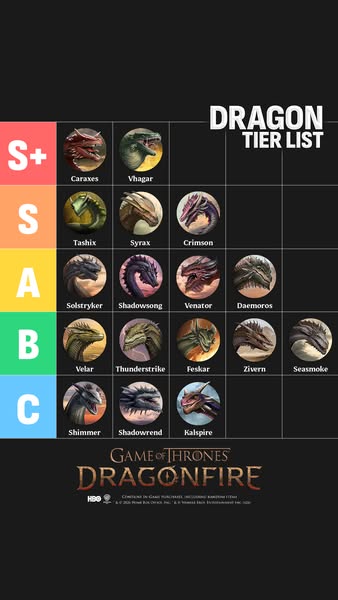
AI Edit Master Prompt
Using the attached image as the layout reference: keep the tall dark near-black background, a bold two-line all-caps white title in the top right, and a tier-list grid filling most of the frame with five rows opened by coloured tiles with large white letters — red, salmon, yellow, green and light blue from top to bottom, the top one with a plus sign. Fill the rows with circular portrait icons of original characters or items, each with a thin border and a small white name label beneath, arranged in a loose grid with faint cell dividers and empty cells toward the right. Near the bottom keep a centred logo lockup with a line of small legal text beneath. Set the title to "{YOUR CATEGORY} TIER LIST", the icons and labels to "{YOUR RANKED ITEMS AND NAMES}", the logo to "{YOUR LOGO}", and the legal line to "{YOUR COPYRIGHT OR DISCLAIMER}".Reference 4
AI Edit Master Prompt
Produce a 1m24s vertical 9:16 talking-head tier list ad for {YOUR BRAND}.

Generate the following sequence:

The Introduction: {A SPEAKER} introduces a tier-list ranking of {YOUR CATEGORY}.

The Body: Quick cuts place competing brands like {COMPETITOR BRANDS} in lower tiers. {YOUR PRODUCT} is ultimately placed in the S tier. He highlights {KEY SPEC}, {GUARANTEE} and {STANDOUT BENEFIT}.

The Final Look: He recommends {YOUR BUDGET PRODUCT} as an A-tier budget option and directs viewers to a link to avoid low-quality replicas.

Assemble: Fast-paced jump cuts synchronized with the on-screen tier list graphic updates.

Text Overlay: A continuous tier list graphic with pop-up product images for each mentioned brand.

Audio: Direct, informative voiceover reviewing the products.

End Card: Concludes naturally on his call to action to buy the originals from the link below.
Reference 5
AI Edit Master Prompt
Produce a 2m45s vertical 9:16 talking-head tier list ad for {YOUR BRAND}.

Generate the following sequence:

The Introduction: {A SPEAKER} introduces a ranking of the best paid {YOUR CATEGORY} services.

The Body: He ranks various strategies, placing {OPTION 1} in B tier, {OPTION 2} in S tier and {OPTION 3} in C tier. {OPTION 4} is also ranked as S tier.

The Final Look: He pitches his own proprietary {YOUR OFFER} that combines {OPTION 2} and {OPTION 1}, announcing he is taking on a new batch of {YOUR AUDIENCE}.

Assemble: A straightforward talking-head edit featuring a continuous digital tier-list graphic positioned above the speaker.

Text Overlay: A digital tier list graphic updating with respective service icons.

Audio: Direct, conversational voiceover explaining the pros and cons of each service.

End Card: Concludes naturally on his verbal call to action to submit {WHAT VIEWERS SEND} via the link below.